Colorado requires motor vehicle salespeople at used-only and powersports dealerships to secure a surety bond, which protects customers from financial harm caused by fraud or rule violations. The bond serves as a three-party guarantee—involving the salesperson, the state, and a surety company—to enforce ethical practices like preventing title or odometer tampering.
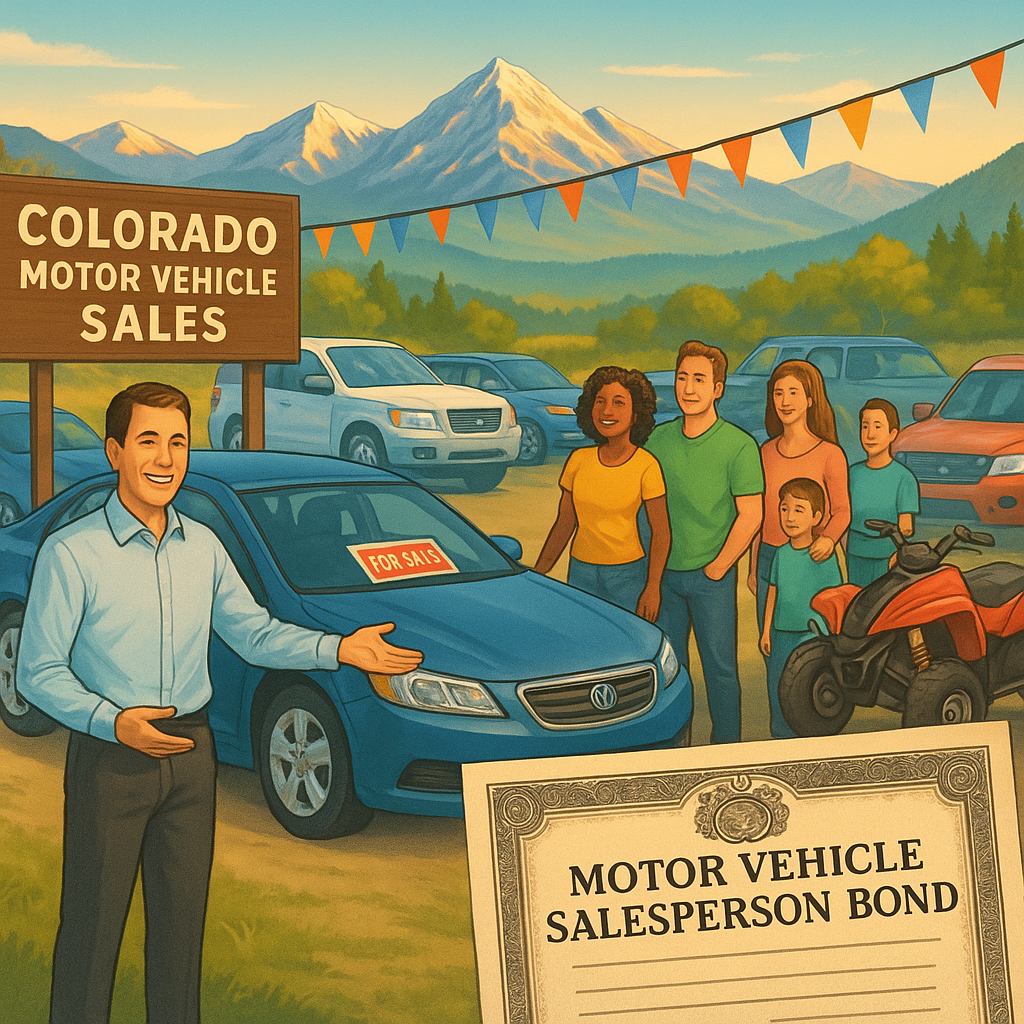
So, you’ve decided to dive into the exciting world of vehicle sales in Colorado. Maybe you’ve landed a job at a used car lot, or you’re passionate about powersports—motorcycles, ATVs, snowmobiles—and you’re ready to help customers find their dream machine. But before you can shake hands and hand over the keys, there’s one crucial piece of paper you need to understand: the Colorado Motor Vehicle Salesperson Bond. Don’t let the name intimidate you. Think of it as a safety promise that protects your customers and gets your license off the ground. Let’s break it all down in plain, everyday language.
What Exactly Is a Colorado Motor Vehicle Salesperson Bond?
Imagine you hire a contractor to remodel your kitchen. You’d want some assurance that they’ll do the job honestly and follow the rules, right? A surety bond is a lot like that—but for the car sales world. The Colorado Motor Vehicle Salesperson Bond is a three-party guarantee. It involves you (the salesperson), the state of Colorado (the obligee), and a surety bond company. The bond says, “I promise to follow all the state laws and regulations when selling vehicles. If I don’t, and a customer gets hurt financially because of my actions, there’s money set aside to make things right—up to a certain amount.”
It’s not insurance for you. It’s a credit-based product that protects the public. And in Colorado, if you’re selling used vehicles or powersports vehicles as a licensed salesperson, you almost certainly need one.
Who Needs This Bond? The “Used Vehicles Only” Clue
Here’s where many new salespeople get tripped up. Not every salesperson at every dealership needs this specific bond. The requirement mainly targets salespeople who work for a dealer that sells used motor vehicles only. If you’re at a franchise dealership that sells both new and used cars, the licensing rules are a bit different. But for independent used car lots, the state wants every salesperson on the floor to carry their own bond.
And there’s a parallel path for powersports enthusiasts. If you work at a powersports dealership selling vehicles like motorcycles, side-by-sides, personal watercraft, or snowmobiles, the Colorado Powersports Vehicle Salesperson Bond covers you. The state lumps these into a similar category because, just like with used cars, consumers need protection from shady deals, odometer fraud, title problems, or misrepresentation.
A quick memory trick: If your dealership’s tagline could be “We sell dreams on pre-loved wheels” or “Adventure starts here with powersports toys,” chances are you need a salesperson bond.
Why Does Colorado Require This Bond Anyway?
Think back to that kitchen contractor example. The state wants you to succeed, but it also wants to keep bad actors in check. The Colorado Auto Industry Division oversees motor vehicle sales, and they use the bond as a tool to enforce ethical behavior. Here’s what the bond indirectly encourages you to do:
- Never forge or alter a title or odometer reading.
- Always disclose a vehicle’s salvage history or known defects.
- Follow all advertising rules—no bait-and-switch pricing.
- Remit taxes and fees properly.
- Handle customer deposits and trade-in paperwork honestly.
If a customer suffers a financial loss because you broke one of these rules, they can file a claim against your bond. That’s the teeth behind the requirement.
How Much Does the Bond Cost and What’s the Coverage Amount?
Let’s talk numbers, because your wallet matters. For both the used motor vehicle salesperson bond and the powersports version, the required bond amount is typically $5,000. That’s the maximum amount a surety company will pay out for a valid claim. But here’s the good news: you don’t pay the full $5,000. You pay a small premium—usually a percentage of that amount.
So, what determines your premium? Mostly your personal credit score. If you have strong credit, you could pay as little as $100 per year for a $5,000 bond. If your credit has some bumps, the premium might be higher, maybe $200 to $500. Even with less-than-perfect credit, most applicants can still get bonded; the price just adjusts to reflect the risk as the surety sees it. It’s a bit like getting a loan—the better your financial history, the sweeter the rate.
A real-world example: Maria just got her salesperson license and her credit is in the mid-700s. Her bond premium was $105 for a one-year term. Her co-worker walked in with a 620 credit score, and his premium came to $200. Both got bonded that same day and were ready to sell.
Step-by-Step: How to Get Your Bond and License
Feeling ready to get started? The process is surprisingly straightforward when you know the order of things. Follow along and you’ll be on the sales floor in no time.
1. Apply for Your Salesperson License with the State
Before the bond, you’ll need to submit your license application to the Colorado Auto Industry Division. This usually involves a background check, fingerprinting, and a licensing fee. Make sure your employer is a legally licensed dealer, because you can’t get a salesperson license without a sponsoring dealership.
2. Gather Your Personal Information
The surety bond company will need your name, address, social security number (for a credit check), and the exact business name of your dealership. Having this info handy speeds up the process.
3. Choose a Reputable Surety Bond Agency
You can work directly with a bond agency or an insurance broker who specializes in surety bonds. Look for one that knows Colorado’s automotive rules inside and out. Many can issue the bond electronically the same day.
4. Pay Your Premium and Receive the Bond Form
Once approved, you’ll pay your premium and get a completed bond form. This isn’t just a receipt; it’s the official document that carries the seal of the surety company and the state-required language.
5. File the Bond with the State
Send the original bond—or an electronic version if allowed—to the Auto Industry Division along with your application. Some surety companies will file it for you, saving you a step. Always double-check that the state received it and your license is marked active.
Remember, the bond must stay active for the entire life of your license. If you let it lapse, your license can be suspended faster than a sports car hitting 0-60.
What Happens If Someone Files a Claim Against My Bond?
Nobody likes to think about worst-case scenarios, but understanding them will help you sleep better. If a consumer files a valid claim—say you accidentally sold a vehicle with a washed title and the buyer suffered a loss—the surety company will investigate. If the claim is proven true, the surety pays the consumer up to the bond’s penalty limit, usually the full $5,000.
Here’s the critical part: you, the salesperson, are legally obligated to reimburse the surety for every penny they pay out. The bond is a guarantee, not a gift. That’s why treating every transaction with honesty is your best protection. Think of your bond as a credit card you give to your customers for emergencies—you’ll have to cover the bill if it gets used.
Powersports Salesperson Bond: Snowmo-beels and Everything Else
We’ve sprinkled in mentions of powersports, but let’s give it the spotlight it deserves. Colorado’s love for outdoor recreation means powersports vehicles are a huge market. Whether you’re selling a jet ski for mountain lake trips, a dirt bike for backcountry trails, or a UTV for ranch work, the same bonding rule applies. The bond amount is again $5,000, and the application mirrors the used car version. The state simply wants to guarantee that you won’t sell a powersports vehicle with a hidden lien, misrepresent its condition, or skip out on the required title transfer.
One neat analogy: If a used car salesperson bond is your city car shield, the powersports bond is your off-road helmet. Both guard against impacts, just in different terrains.
Common Questions That Pop Up Along the Way
Let’s tackle a few head-scratchers you might be whispering to yourself right now.
“Can I use my dealer’s bond instead?” No, a dealer’s bond covers the dealership entity itself. Your employer has one, but the state requires each licensed salesperson at a used-only or powersports dealership to carry their own individual bond. It’s like a passenger on a bus having their own seatbelt—extra layer of safety.
“I have a less-than-perfect credit history. Will I be denied?” In most cases, no. Surety markets have programs for all credit types. You might pay a higher premium, but approval rates are high. Bad credit doesn’t automatically stop your career, it just nudges your cost upward.
“How long does the bond last?” Most bonds are written for a one-year term and must be renewed annually. You can often lock in multi-year pricing with some agencies if you pay upfront, but the norm is a yearly renewal cycle that aligns with your license expiration.
“Does the bond cover me if my customer slips on the lot?” Absolutely not. The bond is strictly for financial losses caused by illegal or unethical acts—fraud, misrepresentation, title issues, etc. It does not replace general liability insurance.
Turning This Requirement Into a Trust-Building Advantage
Rather than seeing the bond as another hurdle, flip the script. When a potential buyer hesitates at your lot, you can mention, “Colorado requires every salesperson here to carry a $5,000 bond. That means the state has a financial stake in making sure I treat you fairly. I’m literally bonded to back up my word.” That kind of transparency builds instant trust and can set you apart from online sellers who offer zero accountability.
Ready to Hit the Ground Running?
Getting your Colorado Motor Vehicle Salesperson Bond (or the powersports version) is a small step that leads to big opportunities. The $5,000 coverage shows you’re serious, and the annual premium is one of the lowest overhead costs you’ll have in your sales career. So, collect your info, reach out to a knowledgeable bond provider, and make that final push toward your license. Your future customers—and your bank account—will thank you for doing it the right way, right from the start.