ROW permit bonds in Denver protect the city and project stakeholders by guaranteeing contractors complete public right-of-way work correctly and pay all laborers and suppliers. Required for permits, these bonds serve as a financial safety net that covers unfinished or substandard work, preventing taxpayer-funded fixes and ensuring fair payment across the construction chain.
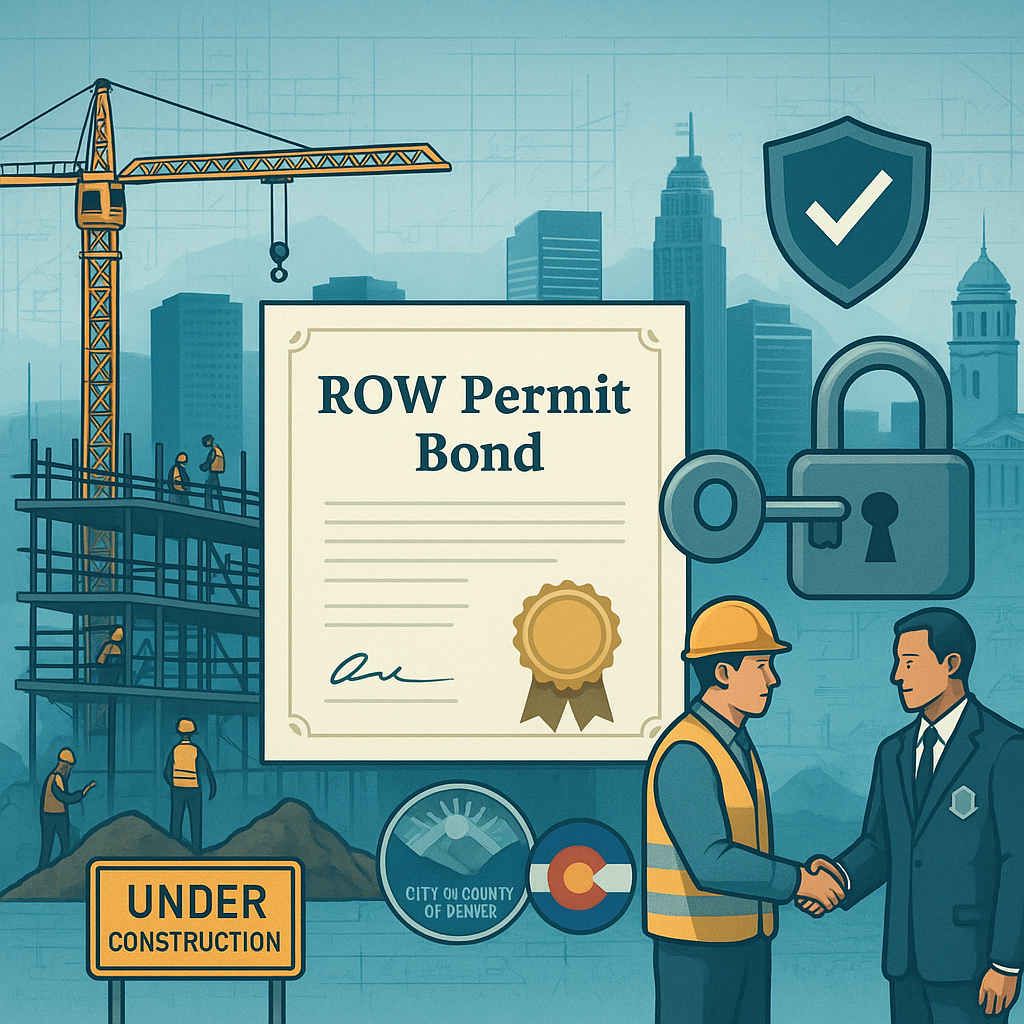
If you’re a contractor planning to dig up a sidewalk, install utilities, or do any kind of work in Denver’s public right-of-way, you’ve probably come across the term ROW Permit Bond. It might sound like just another piece of paperwork, but this bond is a big deal. It protects the city, subcontractors, suppliers, and even you. So, let’s unpack what a Denver ROW Payment and Performance Bond really is, why it matters, and how you can get one without a headache.
What Exactly Is a ROW Permit Bond?
ROW stands for Right-of-Way. Think of it as the strip of land the city owns alongside streets and sidewalks—the space where utility lines, fiber optic cables, and water pipes live. When you want to work in that space, Denver requires a permit. And with that permit, you often need to post a bond.
A Payment and Performance (ROW Permit) Bond is a three-party promise. You, the general contractor, buy the bond from a surety company. The bond guarantees to the City and County of Denver that you’ll complete the work according to all the rules and that you’ll pay everyone who helps you along the way—laborers, material suppliers, equipment rental companies. If you don’t, the bond steps in to make things right.
In simpler terms: It’s like a financial safety net wrapped around your project. The city knows that even if something goes wrong, there’s money set aside to fix it.
Why Does Denver Require This Bond?
Imagine a busy Denver street torn open for a water line repair. The work gets half done, and the contractor disappears. Now the city has a giant hole, angry neighbors, and a safety hazard. Who pays to repave the road and finish the job? Without a bond, the taxpayers might be left holding the bill.
Denver uses ROW permit bonds to make sure that your project doesn’t become their problem. The bond requirement isn’t about distrust—it’s about shared responsibility. The city trusts you to do the work, but they also want a backup plan. This protects public infrastructure and keeps small mishaps from turning into expensive nightmares.
And it’s not just the city that benefits. If you’re a subcontractor laying conduit or a concrete supplier delivering to the site, this bond guarantees you’ll get paid for your contribution. It creates a fairer, more reliable construction environment for everyone involved.
Breaking Down the Two Parts: Payment and Performance
A ROW permit bond in Denver is actually two protections rolled into one product. Let’s look at each side:
The Performance Side: Getting the Job Done Right
The performance part promises that you will complete the project according to the approved plans, Denver’s specifications, and all local codes. If the work is left unfinished or done poorly, the city can file a claim against the bond. The surety company then investigates. If the claim is valid, the surety either pays to have the work completed by another contractor or compensates the city up to the bond’s limit.
Think of it as a guarantee that your promising start turns into a clean finish. The sidewalks get restored to their original condition. The asphalt gets patched smoothly. No loose ends left flapping in the Colorado wind.
The Payment Side: Taking Care of Your People
The payment portion protects the workers and suppliers who make your project possible. If you fail to pay a subcontractor for trenching services or a hardware store for materials, those unpaid parties can make a claim on the bond. This keeps project relationships healthy and prevents mechanics’ liens from being slapped onto public property.
For subcontractors and material suppliers, knowing a bond is in place often means they’ll work with you more confidently. You become a contractor who values fair play, and that reputation goes a long way in a tight-knit industry.
Who Needs a Denver ROW Payment and Performance Bond?
Not every small project triggers the bond requirement. Generally, Denver requires this bond for general contractors doing excavation, trenching, utility installation, or significant restoration work in the public right-of-way. The bond runs directly to the City and County of Denver as the obligee.
Typical scenarios include:
- Installing or repairing water, sewer, or gas lines beneath streets.
- Placing underground fiber optic or electric cables along sidewalks.
- Building or modifying driveways that connect to a public road.
- Landscaping projects that require extensive curb and gutter work.
If the city’s Department of Transportation and Infrastructure (DOTI) requires a permit and labels your project as needing a bond, you’ll have to secure it before breaking ground.
How Does the Bond Process Work? A Simple Walkthrough
Getting a ROW permit bond might sound intimidating, but it’s actually a straightforward process. Here’s how it typically goes:
- Determine the required bond amount. Denver will tell you the specific coverage they need. The amount usually reflects the scope and risk of the project—sometimes it’s a fixed amount like $10,000 or $25,000, but larger jobs can climb higher.
- Apply through a surety company or bond agency. You’ll provide basic information about your business, the project, and in some cases your personal credit history. Don’t worry—even contractors with not-so-perfect credit can often get bonded.
- Get a quote and pay the premium. You won’t have to pay the full bond amount. Instead, you pay a small percentage, typically between 1% and 3% of the total. That premium is your cost of doing this particular project.
- Receive your bond form. Once approved, you’ll get the official document. You submit it to the city along with your permit application. Then you’re good to go.
- Stay compliant and complete the project. As long as you finish the work according to the rules and pay your bills, the bond sits quietly in the background. After the city inspects and signs off, the bond is closed.
What Does a ROW Permit Bond Cost?
Here’s the good news: you are not writing a check for the full bond amount. If Denver requires a $20,000 bond, your out-of-pocket cost might be only $200 to $600. The exact premium depends on factors like your credit score, business financials, and the bond size. Stronger credit means lower rates. Smaller bonds often qualify for simplified underwriting, making them quick and affordable.
Think of it this way: for the price of a modest tool or a nice team lunch, you buy the trust of the city and peace of mind for everyone on the job.
What Happens If a Claim Is Filed?
Let’s be real. Nobody wants a bond claim. But understanding how one works can help you avoid it. A claim can come from the city if your work doesn’t meet specifications or is abandoned. It can also come from an unpaid subcontractor or supplier.
When a claim is filed, the surety company will investigate. If it’s found valid, the surety pays up to the bond limit. But here’s the key part—the bond is not insurance for you. You are ultimately responsible for that money. The surety will seek reimbursement from you for every penny they paid out. So, in the end, you pay. That’s why it’s crucial to finish your work properly and keep your financial obligations in check.
A claim can also make it harder and more expensive to get bonded in the future. So, treat the bond as a serious commitment, not just a bureaucratic hurdle.
Common Misconceptions Cleared Up
Let’s tackle a few myths that often float around the construction community:
- “It’s just like insurance.” Not quite. Insurance protects you from accidents and unexpected events. A bond protects a third party—the city or your suppliers—from your failure to perform or pay. And as we just covered, you have to repay the surety for any claims.
- “I only need a bond if I’m a big company.” False. Even solo operators and small LLCs working in Denver’s right-of-way often need this bond if the permit calls for it. The size of your business doesn’t exempt you.
- “Once I have a bond, I’m covered forever.” Not correct. Each bond is typically tied to a specific project or a permit timeframe. You’ll need to secure a new one for each new ROW project that Denver bonds.
How the Bond Benefits Your Business (Yes, Really)
It’s easy to see the bond as an annoying expense. But flip the perspective. By carrying a required ROW permit bond, you’re signaling to Denver, to subcontractors, and to potential clients that you run a professional, trustworthy operation. You’re pre-qualifying yourself as a contractor who plays by the rules. This can give you a competitive edge when bidding on public and private projects alike.
Moreover, having a bond in place often streamlines the permitting process. City officials see you’ve done your homework, and that small bit of trust can help your project move forward without unnecessary delays. It’s a nuisance that quietly works in your favor.
A Quick Analogy to Bring It All Together
Imagine you’re borrowing a neighbor’s expensive lawnmower. Your neighbor says, “Sure, but I need you to promise you’ll return it in the same condition and pay for any damage.” You shake hands, but the neighbor still feels a bit uneasy. Now imagine you give your neighbor a deposit equal to the mower’s value, held by a friend. That deposit is your bond. It tells the neighbor, “If I mess up, the money is there to make it right.” That’s exactly what your ROW permit bond does for Denver and the people working alongside you.
Steps to Get Your Denver ROW Bond Today
Ready to move forward? Here’s a simple checklist:
- Confirm your bond requirement: Check with Denver’s DOTI or your permit coordinator to get the exact bond amount and type needed.
- Grab your paperwork: Have your business license, contractor’s license, and basic financial info ready. If you’re a new business, a personal credit check may be required.
- Reach out to a bond specialist: A reputable surety agency can shop rates and find a program that fits your situation—even if you’ve had credit bumps in the past.
- Review the bond form: Make sure the named obligee reads “City and County of Denver” and all project details are correct.
- Submit with your permit application: Then, get to work and build something great.
Don’t let the bond process bog you down. It’s a small step that protects a huge investment—yours, the city’s, and everyone else’s along the way.
Final Thoughts
Understanding the Denver ROW Payment and Performance Bond doesn’t require a legal degree. It’s simply a promise backed by money—a promise to do the job correctly and pay the people who help you do it. Whether you’re laying underground cable or restoring a historic street, securing this bond shows respect for the community and a commitment to quality.
Next time you glance at a permit requirement and see “bond needed,” you’ll know exactly why. More importantly, you’ll already be on your way to earning the kind of reputation that keeps your phone ringing with new opportunities. After all, in Denver’s ever-growing landscape, dependable contractors are the true backbone of the city’s infrastructure. And that bond? It’s just one piece of the puzzle that helps you build safely, fairly, and successfully.